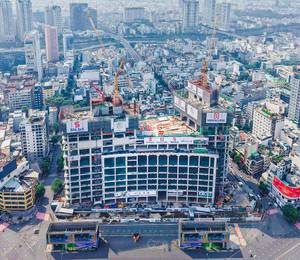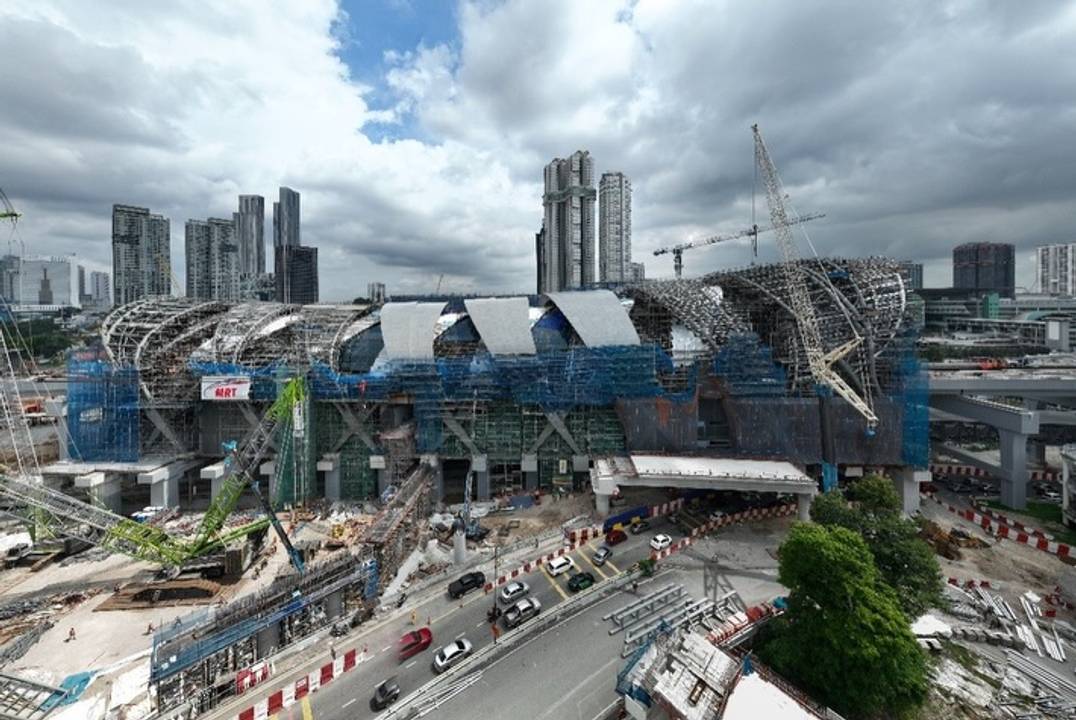
Malaysia Rapid Transit Corporation Sdn Bhd (MRT Corp) has reached another key milestone on the Johor Bahru–Singapore Rapid Transit System (RTS) Link project, with the completion of the inner facade steel bands at the Bukit Chagar Station in Johor Bahru. These inner bands serve as the station roof, providing permanent protection over the platform areas and giving the station its defining structure.
With the roof now in place, the temporary protective shelter above the tracks can be removed. This opens up the site significantly, allowing contractors to move more freely and advance platform works, architectural finishes and systems installation in a more efficient manner.
The completion of the inner bands also allows facade works to move into their final phase, with external cladding and glass installation now underway. Together, this milestone brings the project another step closer to operational readiness, as it progresses towards its targeted commencement of service on 31 December 2026.
The facade installation works were awarded in January 2024 to Rohas Sediabena Builders Consortium Sdn Bhd, a joint venture between Rohas-Euco Industries, a wholly-owned subsidiary of Rohas Tecnic Berhad, and Sediabena Builders Sdn Bhd.
“This milestone goes beyond the completion of a physical structure. It reflects how national infrastructure can serve as a platform for Malaysian capability development, collaboration and excellence,” said Datuk Mohd Zarif Hashim, CEO of MRT Corp. “What makes this achievement especially meaningful is that the facade’s final design development, fabrication, construction and installation have been carried out entirely by Malaysian contractors.”
“The RTS Link station facade is a complex structure that demands careful planning, coordinated fabrication and disciplined execution,” explained Amirul Baharom, group CEO of Rohas Tecnic Group. “From large-scale off-site fabrication to on-site installation, this milestone demonstrates that Malaysian companies have the capability, capacity and systems to deliver major infrastructure to international standards. We are proud to contribute to a project of national significance that sets a strong reference for quality and delivery in the local construction industry.”
‘The Integration of Two’
Conceived as more than a functional structure, the station facade has been designed as a defining gateway for Johor Bahru and a visible expression of the close and enduring relationship between Malaysia and Singapore. Titled ‘The Integration of Two’, the design reflects centuries of shared history and exchange, now reinforced through seamless cross-border rail connectivity.
The facade concept was selected through a national architectural competition organised by MRT Corp in collaboration with Pertubuhan Akitek Malaysia in 2020. The winning design was submitted by Johor Bahru-based architect firm, SM Architects Sdn Bhd. MRT Corp then assessed its suitability for implementation together with a Hong Kong-based consultant.
Once its feasibility was confirmed, MRT Corp proceeded to entrust the detailed design development, fabrication and installation of the facade entirely to Malaysian contractors. This reflects MRT Corp’s commitment to building local capability while delivering infrastructure to international standards.
Inspired by the image of two hands holding each other’s wrists, the facade symbolises mutual support and shared purpose. Sixteen overlapping steel bands comprising eight inner and eight outer bands, wrap around the station concourse and platforms, responding to movement, light and climate. A glass roof spans between the bands creating a skylight that allows natural light to shape the station’s internal spaces.
Given the tight site conditions at Bukit Chagar and multiple work packages progressing in parallel, MRT Corp’s management and construction management teams worked closely with Rohas Sediabina to carefully sequence the facade installation, with safety and risk management as the overriding priority. This ensured the works were carried out without compromise while maintaining overall construction momentum across the station.
The roof facade structure measures approximately 50 m in height, 200 m in length and 50 m in width, incorporating 16 steel bands, a rainscreen system, skylight and spire. According to MRT Corp, more than 40,000 sq m of fabrication capacity across specialised facilities in Bentong, Seremban and Tapah were utilised to meet rigorous engineering and quality requirements.
Image: MRT Corp