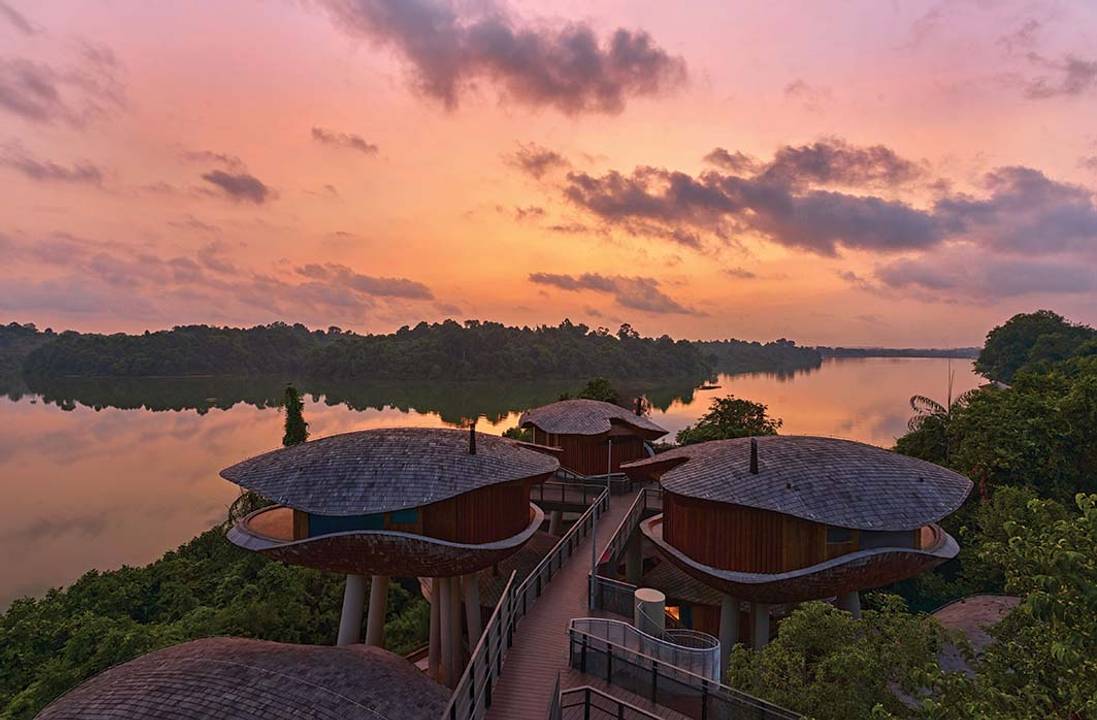
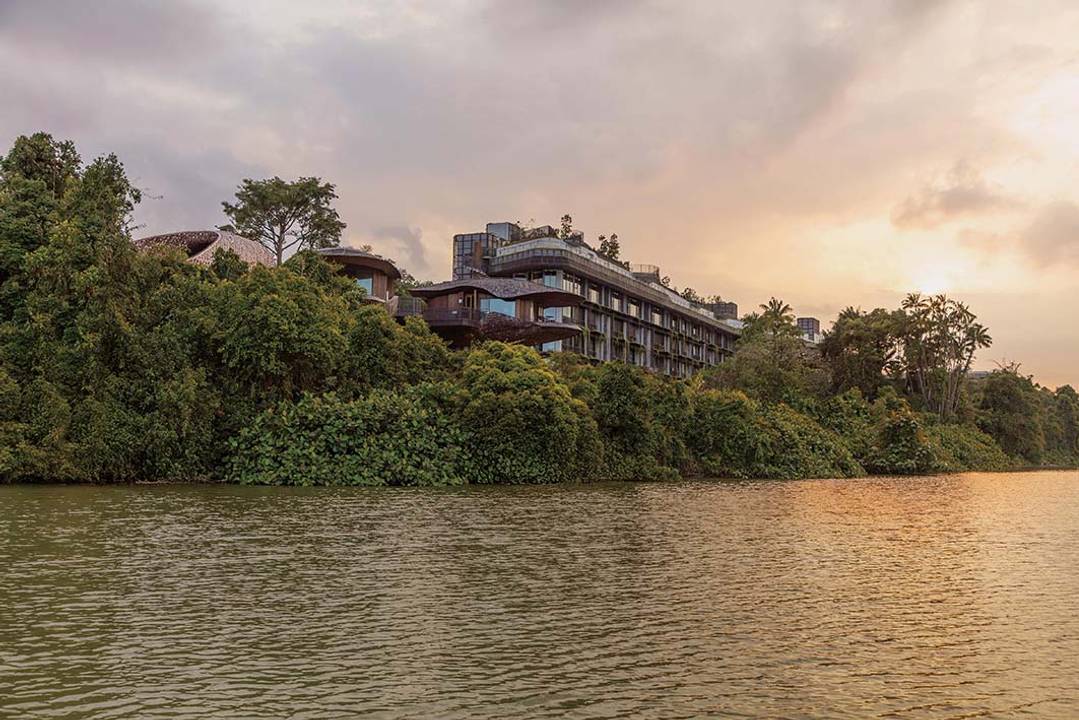
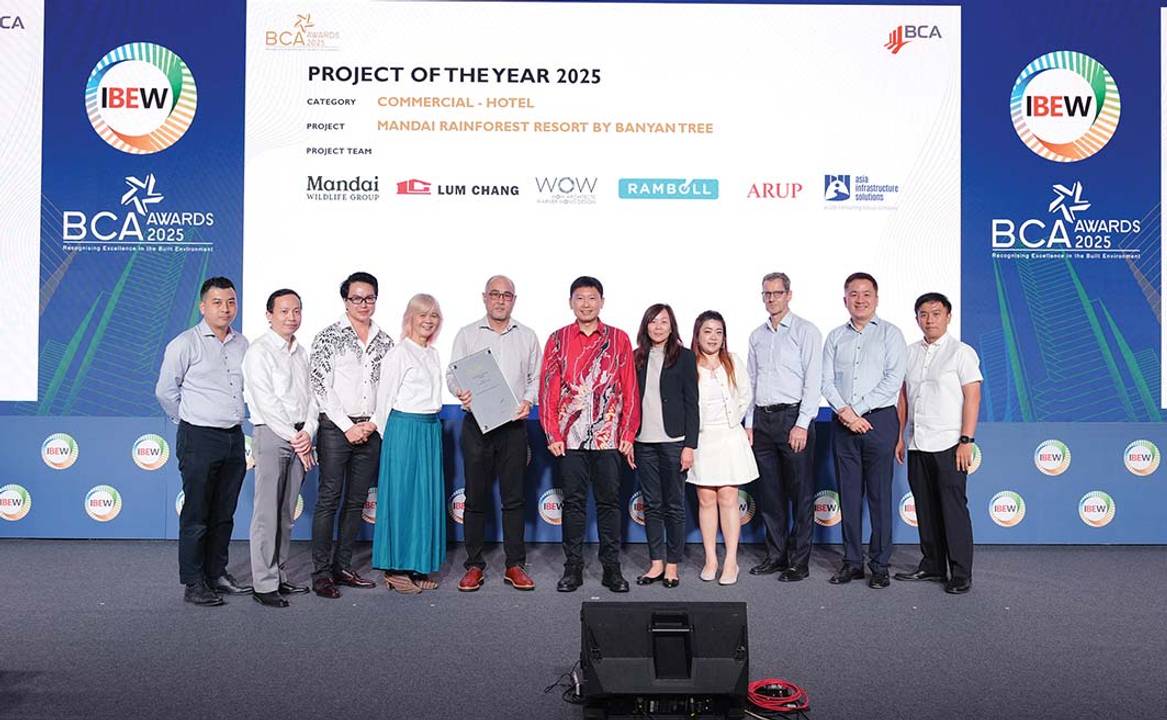
Officially opened on 26 November 2025, the Mandai Rainforest Resort by Banyan Tree has won the BCA Project of the Year Award 2025 in the Commercial Buildings category. Located within the Mandai Wildlife Reserve, this new development was beautifully designed to blend in with nature, with sustainability practices adopted throughout the construction process.
The project focused on “three design principles: in harmony with the environment, weaving in sustainability, and contiguous landscaping,” explained David Goh, project director at Mandai Wildlife Group.
Salvaged tree barks and branches from the site were recycled as moulds for off-form precast concrete walls, allowing the facade to capture natural textures. Such an effort eliminated separate architectural finishing works. As a result, the speed of completing the building’s exterior doubled, saving approximately 77% of man-hours.
Some other green features include “the use of passive displacement ventilation (PDV) for the treehouses, onsite water recycling through rainwater harvesting, and guest room management system and smart room panels to encourage energy conversation by guests,” added Mr Goh.
The contractor, Lum Chang, developed a 6D BIM that was handed over to the client, Mandai Wildlife Group. The system could enable a fully digital approach across design, construction and operations – facilitating automated data transfer from the building model to the facilities management system. If adopted, it could reduce man-hours needed to process operational data by up to 30 times.
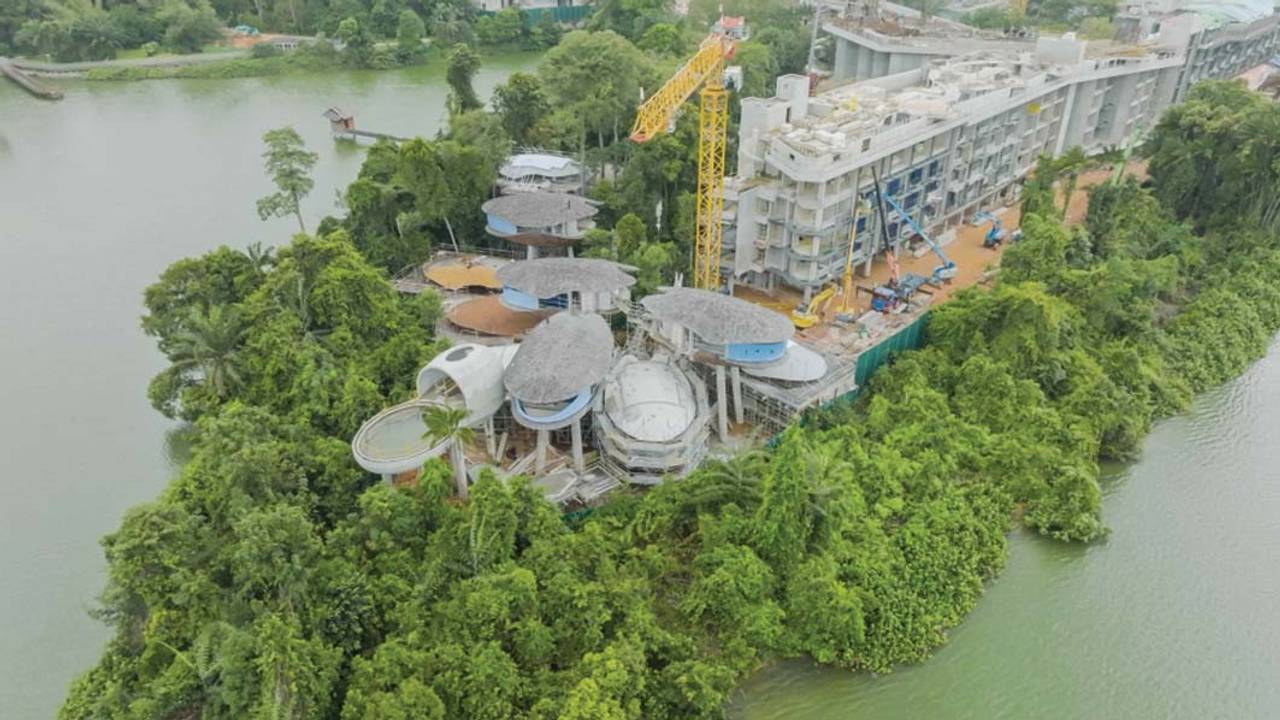
There were also the implementation of BIM-to-field workflows, monitoring and progress tracking with the use of drones, and the adoption of Autodesk BIM 360 Docs for structured exchange of models between consultants, contractors and subcontractors. “Data from the drones was used for site planning, safety inspections and work coordination,” said Mr Goh.
Off-site construction
Advanced manufacturing and assembly (AMA) methods were employed on the project, including extensive off-site fabrication of various structural, architectural, and mechanical, electrical and plumbing (MEP) elements.
Among these prefabricated elements are “spiral steel staircases, elevated walkways, east and west pool pavilions, and wellness pods,” shared Mr Goh. First, the units were designed and coordinated in 3D BIM. They were then constructed in the factory, before being disassembled for transport and reassembled on-site.
The AMA initiative shortened the construction time, minimised disruptions to the surrounding areas, and reduced the environmental impact.
Mr Goh further highlighted that to enhance on-site productivity, the project team provided a comprehensive training and mentorship programme for migrant workers, and also a training programme for subcontractors.
Collaborative business practices, such as providing feedback channels for open communication, as well as using virtual meetings and digital tools to create more efficient meetings, helped ensure the successful delivery of the project.
Project Team
Developer/Owner: Mandai Wildlife Group
Builder: Lum Chang Building Contractors Pte Ltd
Architect: WOW Architects Pte Ltd
Civil & Structural: Ramboll Pte Ltd
Mechanical & Electrical: Arup Singapore Pte Ltd
Quantity Surveyor: Asia Infrastructure Solutions Singapore Pte Ltd
Image credits:
Image 1 & 3: Mandai Rainforest Resort by Banyan Tree
Image 2: Mandai Wildlife Group
Image 4: BCA
Note: This story has also been published in our Jan/Feb 2026 issue. Click here to read it online or here to download the PDF file (pages 48-51).