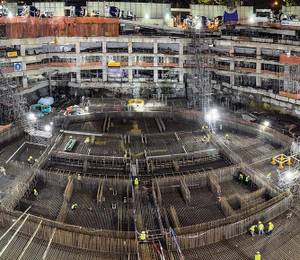
Obayashi Corporation, Iwatani Corporation and Komatsu Ltd have jointly conducted Japan’s first on-site proof-of-concept (PoC) test using a medium-sized hydraulic excavator equipped with a hydrogen fuel cell system (FC excavator) in December 2025. This PoC test was carried out at the Joshin-Etsu Expressway (Rockfall Countermeasure) Kitanomaki (No.2) Construction Project site, under contract from the East Nippon Expressway Company Limited Kanto Regional Head Office.
Promising alternative
Approximately 70% of CO2 emissions at construction sites originate from diesel fuel. In efforts to reduce these emissions, the introduction of hydrogen-powered construction equipment, alongside the adoption of biodiesel fuels and electrification technologies, is considered to be one effective approach.
Since 2023, Komatsu has been conducting PoC tests of its FC excavator, confirming powerful excavation performance and high operability, comparable to diesel engine-powered models, along with the added benefits of zero exhaust emissions and reduced noise and vibration. Compared to battery-powered models, hydrogen-powered systems offer higher energy density and output, making them a promising power source option for achieving carbon neutrality at jobsites that use medium-sized hydraulic excavators.
At the same time, Komatsu recognised the need to validate performance in actual operations and to establish practical hydrogen refuelling methods to move towards broader social implementation.
Against this backdrop, with support from the Nagano Construction Office, Kanto Regional Head Office, East Nippon Expressway Company Limited, the three companies carried out an on-site PoC test from 10 to 23 December 2025 at the Joshin-Etsu Expressway (Rockfall Countermeasure) Kitanomaki (No.2) Construction Project site (a temporary storage yard).
The test involved using the FC excavator for relocating surplus soil and refuelling of the onboard hydrogen tanks on-site. The aim was to assess the practical feasibility of the machine on an actual construction site and to identify potential areas for improvement in hydrogen supply and refuelling methods.
Roles of each company:
-
Obayashi: selection of the construction site (PoC field), planning, execution and overall supervision of the PoC test.
-
Iwatani: hydrogen supply and technical support (differential pressure refuelling system).
-
Komatsu: provision of the FC excavator (concept machine), test planning and technical support.
Based on the results of this on-site PoC test, the FC excavator demonstrated work performance equivalent to that of conventional diesel-powered models. It also confirmed additional benefits, including reduced operator fatigue, reduced engine-induced vibration, as well as improved situational awareness due to lower noise levels.
At the same time, the PoC reaffirmed several challenges to commercialisation, including the need for an increased onboard hydrogen supply and faster hydrogen refuelling. In addition, as the conditions of the construction site evolved along with project progress, the test clarified what kind of jobsite environments are suitable for the safe and efficient use of hydrogen-powered equipment, taking into account the legal regulations on hydrogen refuelling. These insights will be instrumental in shaping future implementation models and establishing criteria for site selection.
Future initiatives
Obayashi, Iwatani and Komatsu will use the insights gained from this PoC test to further develop construction equipment outfitted with hydrogen fuel cell system, explore mobile hydrogen refuelling systems, identify suitable jobsites for implementation, and establish operational standards, while verifying hydrogen refuelling methods for construction equipment under various site conditions.
Scope of each company’s initiatives:
-
Obayashi will study to define criteria for a refuelling station setup within construction sites to support on-site deployment of FC excavators, while working to improve awareness and competency among employees and partner company workers regarding the safe handling of hydrogen.
-
Iwatani will explore the use of a mobile hydrogen refuelling station equipped with liquefied hydrogen. This high-capacity, fast-refuelling system is currently under development with support from the Tokyo Metropolitan Government.
-
Komatsu will continue its efforts towards the commercial production of medium- and large-sized construction machinery equipped with hydrogen fuel cells in the near future by conducting research and development.
By promoting the practical application of hydrogen fuel cell-equipped construction equipment and working with relevant authorities to establish a safe and efficient operational environment for hydrogen use, the three companies aim to reduce CO2 emissions at construction sites and contribute to the realisation of a carbon-neutral society.